Monday, March 12, 2012

A Few Useful Vanagon Modifications

I'm generally not one to insist on keeping a vehicle completely stock, but instead will carefully consider modifications to improve efficiency, comfort and reliability.

That being said, an all original bone-stock Transporter (granted, it was restored to "better than new" condition) can bring a good price, as one 1963 model did recently, selling at an auction for an astounding $198,000.

But that's not Westly, so here are a few low cost additions and modifications I've made so far.  Nothing major here so I hope your're not disappointed.

Sticky Pad
Older Vanagons have a painted metal dashboard with a padded lip out front.  The lip usually keeps things from falling on the floor, but anything up there will still be in motion during every turn.  I've seen a cell phone skate across the dash and right out the window.

This little pad goes on the dashboard, or anywhere else you want to keep your phone, i-pod or other items in place.
The Sticky Pad in action
Also visible - our mascot: glow in the dark Senor Tortuga Lenta
It's made of some kind of really grippy materiel that holds things but doesn't leave a sticky residue on them.  Dust and lint stick to it really well also reducing it's effectiveness so every once in a while I wash it with dish soap and water, let it dry, and it's back in service.  Just a few bucks at Harbor Freight.

Update: After about a year, the sticky pad gradually became the overly-sticky pad, holding on to objects much too dearly and leaving them with tacky stripes when they could finally be wrenched away.  Now it's history.  

On-board Battery Charger
High compression diesel engines require a tremendous amount of cranking amps to get started, particularly in very cold weather.  I had already installed an engine block heater which preheats the water (and oil to a lesser degree, by conduction) for easier starts, but it still helps to have the battery is top condition.  This is generally not a problem on the road, but around town with lots of stops and starts, particularly during fall/winter when the lights and heater fan are often on, an occasional top-up charge is helpful.  Gas powered Vanagons keep their starting battery in a compartment under the front seat.  In the diesel Vanagon it's back in the engine compartment.  I suppose this is so the cable runs can be shorter, resulting in less voltage drop, but I'm not sure.  Anyway, I purchased a 1.5 amp 3-stage charger which is designed to mount in the engine compartment and be permanently attached to the battery.  The first stage is a low, constant current to bring up batteries that are discharged.  The second state is a higher current to top off batteries that are almost fully charged and the third stage is a floating charge that keeps the battery fully charged without overcharging.

On-Board battery charger
I bolted the mounting bracket securely in place near the battery and attached the wires.  It has a short AC cord which just reaches out of the license plate access hole.  Once a week or so, I plug it in overnight.  I've seen some Westys where a charger like this was installed in the cabinet under the stove/sink, plugged into the "extra" duplex there and wired into the camper accessory fuse box nearby. This way, whenever your "shore power" is plugged in, the battery is charging.

Variable Delay Windshield Wiper Relay
The L trim level Vanagon comes with an intermittent wiper delay that's preset to swipe every 5 seconds or so.  Many later Volkswagen cars came with a variable delay feature, and someone figured out that you could take the wiper relay from those cars at the wrecking yard (or spend a week's pay for a new one) and plug it right in taking the  place of the standard Vanagon relay.  Even better, if your Vanagon was not originally equipped with a wiper delay, you can break off a little plastic tab in the switch so it will go into that position, install this relay and have it all.
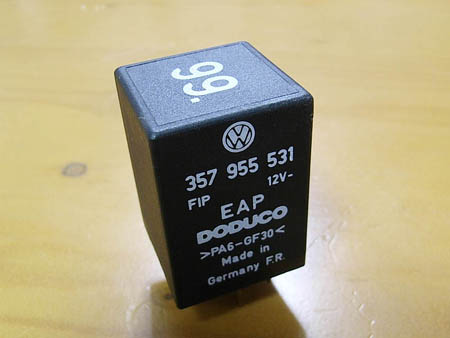
 It's called the 99 relay because of the number printed on top
It works like this:  turn the switch to the delay wiper position, then back off.  After it's been off for the number of seconds (up to 20 ) you want for the delay, turn the switch back to the delay position again.  It will then keep that delay interval as long as the wipers are on.  When you turn them off, it resets.  An easy and very useful mod.

Valve to Control Heater Flow
Water cooled Vanagons have a little issue known as Hot Foot Syndrome.  There are two causes.  First, the radiator is in the front of the van, directly ahead of the passenger compartment.  Radiators cool the water that is flowing inside by using air to conduct the heat away.  The hot air then has to go somewhere.  In the Vanagon, it passes through a cavity behind the radiator, then is directed down and away under the van.  That cavity is adjacent to where the driver has a foot on the accelerator pedal, and a passenger might rest their foot on the other side.  The heat conducted through the metal floor pan makes a great foot warmer in winter, but the rest of the year it can get a little uncomfortable.  The other part of the problem lies with the stock heater control.  Evidently, for whatever reason most do not shut off completely, allowing hot water to continue to circulate through the heater core, thus heating any air that comes through.  So, if you want fresh air blowing through the vents, it will always be heated a little.  Again, great in cold weather, but not so much any other time.  Here's the fix:  First, adhesive backed foil insulation is applied to the cavity area to keep the conducted heat level down.  You can put it inside under the carpet, or outside, or both.  Westly has it outside and that seems to be enough, but then I'm in the Pacific Northwest, which is not exactly known for keeping the mercury elevated. Second, an additional control valve can be added to the water line between the engine and the heater core.  Parker Hannifin makes a high quality ball valve that is very compact and simply shrugs at high water temperatures.  The orange lever on the top turns 45 degrees to open or close the valve.

The Parker Hannifin MV609-8 Ball Valve
with 5/8" barbs added, ready for installation
The valve in place, next to the stock valve
under the dashboard on the passenger side of the heater
Installation is simple  - cut out about 1.5-2 inches of the hose (depending on the length of your valve), insert the valve with hose clamps.  It helps to pinch off the hose on both ends so you don't lose much coolant and end up with a pocket of air. With the valve installed, the flow of hot water to the heater core can be completely shut off, allowing cool, fresh air to be circulated through the system.  Note: I don't know if the heater hoses on the gas engine Vanagons come inside in a position that allows front placement of the valve - I've heard of the valve being installed underneath the van, or back at the engine. The diesel placement is very handy as I can just reach over and turn the valve while driving if necessary.  During the summer when it may be shut off for a long time, I open it periodically to allow fresh coolant to circulate through the heater core.  Maybe it doesn't make any difference, but it makes me feel better.  Also, under a very heavy load (ie - long, steep grades) I will open it to provide additional heat transfer from the coolant.

See more modifications here...


Saturday, March 10, 2012

Awesome Bus Driver Award


One afternoon as I signed in to drive the afternoon commute I was informed there was a "See Me" with my name on it.  These summons to visit with the Chief always give a transit operator pause.  Meeting with your Chief usually means serious business.   My glass must have been 1/2 empty that day, because at first I assumed the worst and began searching my memory - I hadn't been in any accidents (recently). I was generally running the route on time - neither too fast or too slow.  Had I done or said something that could cause a rider to file a complaint?  Then I remembered.

In this case, it was because I had received a commendation from a rider stating that I was always on time, handled situations with riders well, was friendly, capable, skillful, etc. and ended by saying I was awesome!  My Chief (always ready with a smile and encouraging word) congratulated me and told me to keep up the good work.  There's really no tangible reward for this, just an "Atta Boy!" and it goes into my file, hopefully to provide a little offset next time I do something stupid like knock someone's rear view mirror off in downtown traffic.

The operator doesn't often know who sends in a commendation (or a complaint).  I had received one prior to this in which the rider stated they rode on my bus every day for months and had many fond memories of doing so because I was their favorite bus driver.  They didn't tell me in person, and I never was able to figure out who it was.  But this time I knew because she had told me she was going to do it.

Part time Metro operators like myself have the opportunity to change routes every four months or so.  This helps us learn more routes, and keeps us from getting bored driving the same thing all the time.  We go into a room with all the available routes posted on the walls and pick a route and time based on our seniority.  For various reasons, I kept picking the same route at the same time of day for almost a year.  This continuity has some benefits. You get to know where your regular riders' stops are. You know where pretty much everything is around the route so you can answer questions with authority.  And you may get to know some riders on a level beyond the daily "hello" and "goodbye".

I came to know a little about the woman who had sent in the commendation over the many months she rode on my bus each weekday.  I try to respect riders privacy and don't ask a lot of personal questions, but one day I overheard a particularly chatty rider ask her where she was from.  Nigeria, she said.  On another occasion I heard her say she provided overnight care in one of the retirement facilities along the route.

At her stop, I would always say something like "Have a good evening (or weekend)" or "See you tomorrow (or next week)".  She would smile and haltingly repeat the same back to me, as if English were new to her and coming along slowly.  Over time her command of the language improved and she began departing with sentences of her own accord.

A couple of months prior to her call to Metro customer service, she boarded as usual.  Only a handful  of riders were aboard as it was the beginning of a holiday weekend.  At her stop, she said to me "Happy New Year.  God bless you and your family. You have done well", then turned to descend the two steps out of the bus.  She always took these steps slowly (sometimes she did so with a grimace).  At the second step she turned and looked directly at me, her gaze piercing deeply into my very soul.  She held that gaze for what must have been a couple of seconds, but seemed to me much longer.

It was like she could see how I had left my "career" job, closing the doors of a  business that had been in my family for 40 years and wondering what I was going to do now?  How I had taken a desire to help others into a job driving the bus, where no matter how well you do, you're still more likely to get ignored, glared at and cursed then thanked.  How I always did my best to treat every rider equally, whether or not they felt like paying the fare, however they smelled, however slowly they moved, however obnoxiously they spoke.  She seemed to realize the discomfort of the job; sitting for hours, constantly vigilant to avoid accident, sometimes missing breaks, lunch, even restroom stops to keep on schedule.

Somehow she took all that in and never averting her gaze repeated, emphasizing each word,

"You...have...done...well".  

She turned and departed.  I continued on my route.  It was all worthwhile.


The riveting tale of how I came to be a Transit Operator