Tuesday, April 3, 2012

Stealth Van Camping

Camping isn't the bargain it once was.  I remember my mother and dad talking about how our family of six spent about $600 traveling around the US for a month, west coast to east and back.  We hit all the usual attractions including several days in Washington DC, camped everywhere we went, visited friends and family, and never spent a night in a motel or ate at a restaurant. That was in the early '70s.
Camping at Red's Meadow,  in 1974
Preparing for backpacking on the John Muir Trail
I'm on the right in a while t-shirt
Now fuel and food (and Vanagon repairs) are exponentially more expensive.  In Washington State, toll roads and bridges are something new and likely to increase in number.  Then there are campground fees which can run from $15 to $50 a night and more.

Access fees to public lands are now commonplace.  These fees help to cover shortfalls in state and federal budgets so we can continue to enjoy these areas and facilities.  I don't like paying all these fees, but I don't try to get around them.  If these recreation and wild areas close to public use, they are unlikely to re-open any time soon.  And if they are auctioned off for development or harvesting of natural resources, it's a huge loss to us now and to future generations.

In Washington state we have the Discover Pass which, according to their website grants these benefits:

The Discover Pass allows you to enjoy nearly 3 million acres of Washington state-managed recreation lands – including state parks, water-access points, heritage sites, wildlife and natural areas, trails and trailheads.

All for only $35 annually ($30 + $5 dealer fee). Signs are popping up in even in the most remote places prompting the visitor to display the pass prominently or risk a $99 fine.  It may be transferred between two vehicles.

For National Forests, there is the NW Forest Pass, which covers Washington and Oregon.  It's also $35 for the annual pass, and necessary for parking at any trail head, picnic area or boat launch in National Forest recreation sites.  It is transferable between vehicles in a household.  If you travel around many states, an inter-agency pass is available.

There's also the Washington State Dept of Fish and Wildlife Vehicle Access Pass which comes with a fishing or hunting license.  This allows access to state wildlife lands, but not Dept of Natural Resources areas or State Parks - you need the Access Pass for those.  Additional passes cover boating and winter sports and the Inland Empire Paper Company issues a pass to recreate on it's 116,000 acres in NE Washington and Northern Idaho.  I recently picked up a free pass from Puget Sound Energy to access 10,000 acres around the Wild Horse Wind and Solar Facility in Eastern Washington. If all this seems confusing, that's because it is and we've likely just seen the beginning of it.

So, what is a happy camper on a limited budget to do?  These work for me:

> Slow Down - Most vehicles, and especially brick-like Vanagons, can get substantially more miles per gallon at 55-60 mph rather than 65-75 or higher. You'll still get there - enjoy the trip as part of the adventure!  Note - if you are easily intimidated by hot semi breath inches from your back bumper or are offended by "the look" or "the bird" as others pass, this might not be the best course of action for you.

> Plan ahead for meals - Bring food to prepare from home, where you likely purchased it in a larger quantity, maybe on sale, maybe even with a coupon or two. If you normally buy groceries at the corner Handy Mart anyway, never mind.

> Camp on Bureau of Land Management and State Forest land - They maintain small campgrounds in many areas that are usually free or very low cost, or just find a wide spot with a view on a dirt road somewhere. You need to be somewhat self-contained as there will be no or very primitive facilities.  Depending on the state, you may need a pass as described above.  If you must have a camp fire, disperse the ashes and rocks (if you gathered some) when it's all cool.  And of course, take any garbage (your's and the inconsiderate slob's who was there before you) away when you leave.

> Practice Stealth Van Camping.  No hibachi grills, hammocks or sitting around the glowing embers of the campfire singing another chorus of kum-ba-ya here. The idea is to keep a low profile - close the curtains if you have some, lock the doors, turn out the lights.  If you have a Westy, keep the pop-top closed. Just get some rest and get on your way.

At a Northwest casino - lots of parking and maybe a cheap breakfast
Of course, you don't want to do this all the time. The campground experience is generally paramount in planning a getaway.  But say you are on your way to a destination.  You could arrive by nightfall, and pay the campground fee just to sleep.  Now, if you stealth camp that night, then arrive at your destination next morning feeling fresh and alive, you have the whole day ahead of you and extra $ in your pocket.  Or if you're on a several day trip to your destination, extra $$$.  Just saying...

Ready to go after sweet dreams and hot oatmeal at a rest area in Western Washington
Some places where you might Stealth Van Camp:

     Rest Areas - Most allow sleeping up to 8 hours and have restrooms.
     Truck Stops - Park out of the way of the trucks. Often have showers.  Check out Flying J.
     Wal Mart parking lot - Not allowed in some towns - watch the signs.
     CampingWorld - If there's one of these along your way they allow overnight parking.
     24-hour businesses - Just don't park right at the front door.
     Casinos - People coming and going at all hours.  May need to check with Security for permission.
     Hospitals - Lot's of people hang out there overnight.  Have a "story" ready.
     Hotel/Motel parking lots - Doesn't hurt to ask - they might even let you use the pool.
     Industrial parks - Larger cites have these. Works best if your vehicle resembles a work truck.
     Family / Friends' place - Remember that time you dropped them off at the airport at 4AM and had
        their car in your driveway all week while they were in Hawaii?  Well now they totally owe you
        one  (ok, maybe this doesn't apply to you, but I live near an international airport).

If police or security guards come knocking on your window during the night, be polite.  Explain your situation (on the road, needed a few hours of rest). If they tell you to move on, don't make a federal case out of it. Hit the road and find someplace else.

I lived in Westly for a short time.  It was kind of like camping, except that I had to get up and go to work every day (where I could also shower, so it wasn't that much of an inconvenience).

If you really get into this (some people live in their vans full time), check out Cheaperliving.com for loads of useful tips about living in your car, truck, van or RV.

Friday, March 30, 2012

Westfalia Improvements - Part III

As I've previously mentioned, the Vanagon Westfalia camper conversion is very space efficient.  Sometimes too much so.  So much uitility is packed into a small space that one function can sometimes infringe upon another.

A small forward and larger rear table are ingeniously mounted in a manner that allows them to swivel into place, then stow without removing.  Westly's front table was missing when he rolled into my life and as it didn't seem all that useful, I've never replaced it.

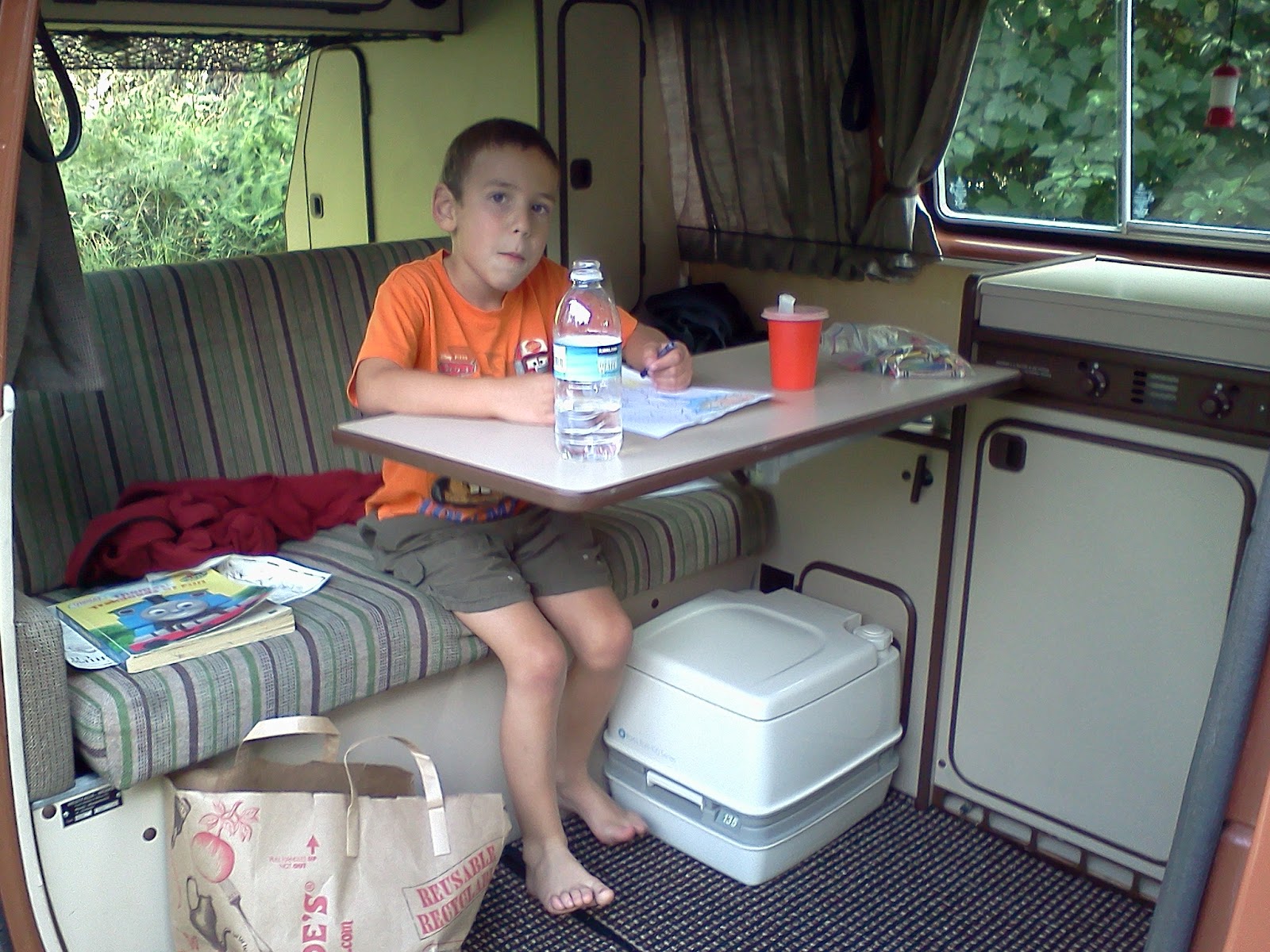
The rear table though is much in demand for food preparation and serving, coloring books, map reading, perusal of the Bentley Manual, etc.   Two locking knobs (In Westly's case two metal rods welded on) allow the table to be locked into a multitude of handy positions.  The table stows nicely out of the way of the seat / bed, but  in doing so blocks access to two storage lockers and the hanging closet.

Van Kid munches on snacks and colors a treasure map at the table
The rear table stowed  - out of the way, but limited access to cabinets
Access to the closet involves cutting the lower part of the door just below the hinge and permanently attaching it to the opening.  I never use the closet that much, so haven't done this.  But Van Kid keeps his clothes and other stuff he can't leave home without in the lockers, so I began to cast about for a solution.  I noticed some Westy owners had modified their tables to be height adjustable and after considering the different ways they accomplished this, I set about shamelessly copying their clever ideas.

Rear Table Height Adjuster

I went to my local home improvement store and purchased a 3/4" X 24" galvanized pipe, a 3/4" PVC box adapter and a 3/4" PVC union.  I cut the pipe to 22"  leaving the orange plastic thread protector on one end.  Then I removed the table swivel base and used a cut-off wheel to detach the original galvanized stub.

Trimmed pipe with the union jammed into one end
The box adapter goes in the hole in the swivel base
The box adapter went into the hole in the swivel base from below, then I bolted the base back in place.  I jammed the union into the end of the pipe with a mallet, then put the pipe down through the table leg hole where the union slipped into the box adapter.

How it all fits together
Swivel base bolted back into place with pipe dropped in
The pipe with plastic sleeve pokes through here
The table legs slips right over it and down to the base
The table leg went back in the hole over the new pipe which is just the right size to fit snugly inside it.  The orange plastic thread protector gives it just enough tension to slide smoothly and eliminate rattles.  Now the table can be raised to any position and locked in place while retaining it's swivel function.  A higher table elevation comes in handy when the pop-top is up and tasks such as cooking are being performed while standing.  And it can be used as a night stand for the top bunk. Parts were about $10.

Raised position allows access to lockers
Outside Table Mount

While I was poking around online finding information about table height adjustment, I came across a thread where cunning Westy owners had made a bracket to mount the table outdoors, using the jack point on the side of the van.  At least one vendor sells this ready-made and it looks real slick, but as usual, I had my own ideas. Gathering some leftover odds and ends from around my shop, I put this together:

What is this thing and why is it in my Westy??
The rear table sets on a adjustable rod
Higher for cooking
It will raise another 11 inches if necessary
Lower for dining
(camping scenes simulated for illustrative purposes)
Pipe fits into jack point, hitch pin holds it in place
Here's what I used:  21.5  inches of 1.5" ABS pipe cut to 12" and 9.5"
                               1.5" X 3/4" PVC T fitting / threaded in the 3/4 opening
                                3/4" X 18" galvanized pipe (leave the orange cap on one end)
                                Suprotek PC-110 rebar pad (the foot)
                                Structron Super Handle - shortened to 23"
                                1/4" X 1-3/4" cotter-less (spring loaded ball) hitch pin
                             
The Super Handle is a telescoping fiberglass pole used by painters and janitors. You twist the two parts in opposite directions to loosen, then the inner part can be raised or lowered.  The threaded end where a brush or broom was intended to be attached is just the right size for the Westy table to rest on.  To trim it to size requires taking it apart and cutting the two parts individually.  When I had the size correct, I epoxied it into the upper (longer) ABS tube.  The two ABS tubes were then attached to the T fitting ( I didn't glue them in so I could break it down for more compact storage), the galvanized pipe was drilled to accept the hitch pin (just inside the jack point opening - see picture).  The rebar foot needed a little sanding to press-fit inside the lower ABS tube.

The foot is not adjustable, as it is on the slick vendor version.  For uneven ground, a rock or stick wedged under the foot will suffice.  The stand flexes a little when people are stepping into and out of the van, but not enough to worry about.  The tire jack can be put in place on the opposite side to stabilize ( BTW - this is also a useful trick to stabilize the van in strong winds or when lots of motion is taking place inside).

After I made this, I saw a jack that was modified with a tube and locking knob on the side so the table and it's leg can be set into it.  Great idea - you're already carrying around the jack in case of a flat tire, and now it has an additional use. I'll try this sometime.

Ground Fault Circuit Interrupter (GFCI)

The AC-110 volt circuit in the Westfalia conversion consists of an outside electrical cord connector, a 15 amp circuit breaker, one duplex mounted below the rear table, and one duplex inside the cabinet below the stove/sink (that's where the fridge plugs in).  The original brown bakelite was cracked and chipped, so I made plans to upgrade.

The GFCI mounted in the proper Euro fashion
It has a tiny LED showing when you're connected to the grid
Black and red buttons are for testing and resetting
The lower plate contains the 15 amp circuit breaker
A GFCI monitors current flowing from hot to neutral, and disconnects the power in about 1/30th of a second if it's imbalanced.  They are required by electrical code in damp areas because in case of a short circuit, you could become the path to ground especially if you are standing in, or have your hands in water which conducts electricity readily. They can prevent a fire, and/or keep you from getting burned, shocked, or electrocuted in situations like a broken cord shorting out, or your curling iron falling in the bath.

Since camping with Westly often includes some type of wet inside and out, it seemed a logical choice to add one.  Because of the circuitry inside, the GFCI tends to be a little deeper than a standard duplex.  I added a deeper utility box to accommodate it (remodel box from Ace Hardware) and new white vinyl plates for the duplex and the circuit breaker.

Seat Back Backpack


Really just an old day pack that was sitting around.  I hung it on the back of the passenger seat where it serves admirably holding a litter bag, first aid kit, extra batteries, coloring books, TP, in short a lot of stuff that we would otherwise be constantly searching for all over the dash, floor, seats, squirreled away in some bin somewhere.  It also detaches easily to use for it's intended purpose.

See more modifications here...